Choosing between M20, M25 and M30 RMC is not simply a matter of ordering the higher grade because it offers greater strength. The correct concrete grade depends on the structural design, application, exposure conditions, project specifications and requirements established by the engineer or consultant.
For builders, contractors and procurement teams looking for RMC in Raipur, understanding the difference between M20 vs M25 vs M30 concrete can make concrete procurement much more straightforward. M20, M25 and M30 represent different characteristic compressive-strength grades, but the grade alone does not determine whether one is appropriate for a particular slab, beam, column, footing or industrial structure.
A higher grade is not automatically the right choice for every part of a building. Similarly, selecting a lower grade simply to reduce the initial concrete cost can be inappropriate if it does not satisfy the project’s structural or durability requirements.
This guide explains what M20, M25 and M30 mean, how they differ, where they may be used, what factors affect the selection and what builders should check before ordering RMC.
What Does M20, M25 and M30 Mean?
The letter M refers to the concrete grade, while the number indicates the characteristic compressive strength of the concrete in MPa after the specified curing period.
In simple terms:
| Concrete Grade | Characteristic Cube Compressive Strength |
| M20 | 20 MPa |
| M25 | 25 MPa |
| M30 | 30 MPa |
Therefore, M30 has a higher specified characteristic compressive strength than M25, and M25 has a higher specified characteristic compressive strength than M20.
This does not mean that M30 should replace M20 or M25 throughout a project. Concrete grade is selected based on engineering requirements, not simply on the principle that stronger concrete is always better.
The project drawings, structural design, applicable standards and engineer’s specification should determine the required grade.
M20 vs M25 vs M30 Concrete at a Glance
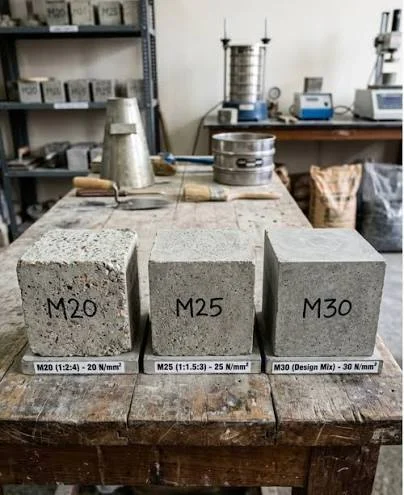
The simplest way to understand the three grades is to compare their characteristic strengths and typical decision context.
| Factor | M20 | M25 | M30 |
| Characteristic cube strength | 20 MPa | 25 MPa | 30 MPa |
| Relative strength | Lower | Medium | Higher |
| Typical consideration | Applications where M20 is specified | Applications requiring higher strength than M20 | Applications requiring higher strength and/or durability requirements |
| Suitable for | Depends on structural design | Depends on structural design | Depends on structural design |
| Selection basis | Engineer’s specification | Engineer’s specification | Engineer’s specification |
| RMC suitability | Available as RMC where specified | Available as RMC where specified | Available as RMC where specified |
The table should be treated as a comparison rather than a universal application chart. A concrete grade should never be selected for a structural member solely from a generic online recommendation.
What Is M20 Concrete?
M20 concrete has a characteristic cube compressive strength of 20 MPa.
It is a commonly recognised concrete grade and may be specified for certain structural and non-structural applications depending on the project design and applicable requirements.
For a procurement team, the important question is not simply whether M20 is “strong enough”. The question is whether M20 is the grade specified for the particular element being constructed.
If M20 is specified for a particular application, ordering M25 or M30 without technical justification does not necessarily improve the project in a meaningful way.
When Can M20 Be Considered?
M20 may be considered where the structural design and applicable requirements permit it.
Potential applications can include certain residential or general construction elements where the structural engineer has specified M20.
However, the actual application must always be checked against the approved structural drawings and project specifications.
What Should You Check Before Ordering M20 RMC?
Before ordering M20 RMC, confirm:
- Required grade
- Quantity
- Pour location
- Delivery schedule
- Required workability
- Reinforcement congestion
- Pumping requirements
- Site access
- Concrete placement arrangements
- Curing arrangements
- Applicable project specifications
The grade is only one part of the concrete procurement decision.
What Is M25 Concrete?
M25 concrete has a characteristic cube compressive strength of 25 MPa.
It provides a higher specified characteristic strength than M20 and may be specified for structural applications where the design requires this grade.
M25 is often encountered in discussions about residential, commercial and other reinforced concrete construction, but its suitability still depends on the structural design and applicable requirements.
When Can M25 Be Considered?
M25 may be selected for structural elements where the design requires a 25 MPa characteristic cube strength.
Depending on the project, it may be considered for elements such as:
- RCC slabs
- Beams
- Columns
- Foundations
- Footings
- Other structural members
However, these should not be treated as automatic M25 applications.
The structural drawings and engineer’s specification remain the controlling documents.
Why Do Buyers Choose M25 Instead of M20?
The answer should normally come from the project’s engineering requirements.
If the design requires M25, substituting M20 simply because it is cheaper would not be appropriate.
At the same time, if the design specifies M20, automatically upgrading every element to M25 may not be necessary.
This is why the right question is not:
“Which is better, M20 or M25?”
The better question is:
“Which grade has been specified for this particular concrete element and why?”
What Is M30 Concrete?
M30 concrete has a characteristic cube compressive strength of 30 MPa.
It therefore provides a higher specified characteristic compressive strength than M20 and M25.
M30 may be selected where structural design, durability requirements, exposure conditions or project specifications call for a higher concrete grade.
It can be relevant to commercial, industrial and infrastructure projects where the design requires higher strength or more demanding performance requirements.
When Can M30 Be Considered?
M30 may be specified for:
- Structural members requiring a higher concrete grade
- Certain commercial structures
- Industrial construction
- Infrastructure structures
- Heavily loaded elements
- Applications where the design requires M30
Again, these are examples of where M30 may be encountered, not a universal rule for every project.
The engineer should establish the appropriate grade.
M20 vs M25 vs M30: What Is the Actual Difference?
The primary numerical difference is characteristic compressive strength.
M20 represents 20 MPa.
M25 represents 25 MPa.
M30 represents 30 MPa.
That difference matters because structural design uses concrete strength as one of the key inputs when designing reinforced concrete members.
However, concrete performance is not determined by compressive strength alone.
Other factors can include:
- Water-cement ratio
- Cementitious materials
- Aggregate characteristics
- Mix proportions
- Workability
- Curing
- Concrete placement
- Compaction
- Exposure conditions
- Quality control
- Transportation
- Time between batching and placement
This is why simply ordering a higher grade does not eliminate the need for proper concrete quality control.
M20 vs M25 vs M30 for RCC Slabs

RCC slabs are one of the most common areas where homeowners, builders and contractors ask which concrete grade they should order.
The answer depends on the structural design.
A slab is designed based on factors such as:
- Span
- Loading
- Support conditions
- Reinforcement
- Structural system
- Exposure
- Building use
- Design requirements
Therefore, there is no universal rule saying that every residential slab must use M20, M25 or M30.
If the structural drawing specifies M25, the RMC order should be placed for M25.
If it specifies M30, M30 should be ordered.
The concrete supplier should not be expected to determine the structural grade without the engineer’s specification.
M20 vs M25 vs M30 for Beams
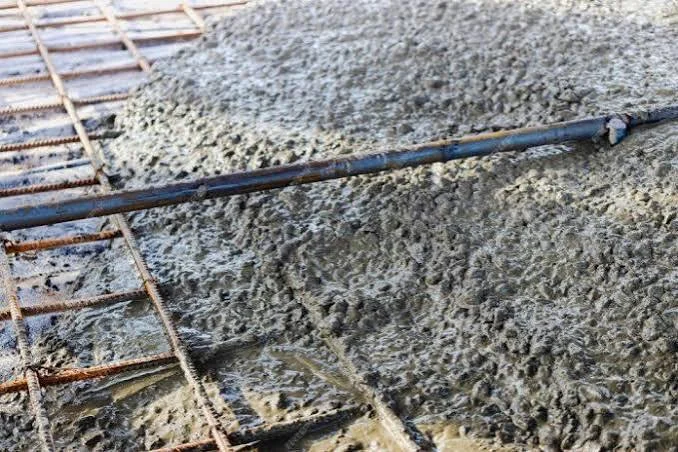
Beams carry loads and transfer them to columns, walls or other supporting elements.
Concrete grade is therefore an important part of structural design.
The selection may depend on:
- Design loads
- Beam dimensions
- Span
- Reinforcement
- Structural system
- Exposure conditions
- Design code requirements
A contractor should refer to the structural drawing before ordering concrete.
If several beam types are present on the same project, the required concrete grade may not necessarily be identical for every element.
M20 vs M25 vs M30 for Columns

Columns are critical structural members because they transfer loads to the foundation.
Concrete grade selection for columns should therefore be based on structural design rather than a generic construction rule.
A project may specify different grades for different structural elements or different stages of construction.
For procurement teams, this makes coordination particularly important.
Before scheduling a concrete pour, confirm:
- Column location
- Concrete grade
- Quantity
- Pour sequence
- Reinforcement readiness
- Formwork readiness
- Pumping requirements
- Delivery timing
- Concrete testing requirements
A mismatch between the ordered grade and the approved structural specification can create serious project complications.
M20 vs M25 vs M30 for Foundations
Foundations transfer structural loads to the ground.
The required concrete grade depends on the structural design, foundation type, soil conditions and applicable durability requirements.
Possible foundation types include:
- Isolated footings
- Combined footings
- Strip foundations
- Raft foundations
- Pile foundations
- Pile caps
The appropriate concrete grade should be taken from the structural and geotechnical design documentation.
For larger projects, foundation concrete may also involve specific requirements related to exposure, durability, placement conditions and quality control.
M20 vs M25 vs M30 for Industrial Projects

Industrial construction often involves more demanding loading and operating conditions than ordinary residential construction.
Concrete may be required for:
- Equipment foundations
- Industrial floors
- Machine bases
- Storage areas
- Structural frames
- Loading zones
- Utility structures
- Drainage systems
- Workshops
- Warehouses
The required grade can vary considerably between these applications.
For example, a machine foundation may have completely different design requirements from a staff building slab.
Therefore, industrial procurement teams should avoid ordering one concrete grade for an entire project unless the engineering specification actually calls for it.
Does a Higher Concrete Grade Always Mean Better Concrete?
No.
M30 has a higher characteristic compressive strength than M25, and M25 is higher than M20.
But “higher strength” does not mean “automatically suitable for every application”.
Concrete is designed for a particular purpose.
Using a higher grade where it is unnecessary can affect project economics without providing a corresponding benefit.
More importantly, higher strength does not compensate for poor workmanship.
For example, problems can still occur because of:
- Poor curing
- Incorrect placement
- Excessive water addition at site
- Poor compaction
- Delayed placement
- Improper finishing
- Poor reinforcement detailing
- Inadequate quality control
The correct approach is therefore to use the specified grade and control the entire concrete process properly.
Is M30 Always Better Than M25?
From a specified compressive-strength perspective, M30 has a higher characteristic strength than M25.
But that does not mean M30 is automatically the better commercial choice.
If a structural design requires M25, using M30 without a design or project requirement may not provide a useful advantage.
The decision should consider:
- Structural requirement
- Durability
- Exposure
- Availability
- Mix design
- Project schedule
- Cost
- Quality-control requirements
The objective is not to maximise concrete grade.
The objective is to meet the project’s engineering requirements reliably.
How Does Concrete Grade Affect RMC Cost?
Concrete grade is one of several factors that can affect RMC pricing.
A higher grade may require a different mix design and material proportions, but the actual price should be obtained from the supplier based on the project requirements.
Other factors can include:
- Quantity ordered
- Delivery distance
- Site accessibility
- Pumping requirements
- Pour size
- Delivery schedule
- Mix requirements
- Additional admixtures
- Special performance requirements
Therefore, it is not advisable to publish a universal “M20 price”, “M25 price” or “M30 price” for Raipur and assume it applies to every project.
A proper quotation should be based on the actual order.
Should You Choose M20 to Save Money?
Not unless M20 is technically acceptable for the intended application.
Concrete procurement should begin with the structural requirement and then move towards commercial comparison.
The correct sequence is:
Engineering requirement → specified concrete grade → quantity → supplier comparison → quotation → delivery planning
The wrong sequence is:
Lowest price → choose grade → hope it is suitable
For structural concrete, the first approach is much safer and more professional.
Should You Upgrade From M20 to M25?
An upgrade should be considered only when it has a technical or project-specific reason.
For example, the engineer may revise the design or specify a higher grade because of structural requirements.
A contractor should not independently change the grade simply because a supplier recommends it.
If a grade change is being considered, the structural consultant or engineer should confirm the change before procurement.
Should You Upgrade From M25 to M30?
The same principle applies.
M30 provides a higher characteristic compressive strength than M25, but the project should use M30 when the design or specification requires it.
An upgrade can involve changes to the mix design and commercial terms, so it should be treated as an engineering and procurement decision rather than a simple product upgrade.
What Factors Should You Consider Before Ordering RMC?
Choosing the correct grade is only one part of ordering ready mix concrete.
1. Concrete Grade
Confirm the exact grade from the approved structural drawing or concrete specification.
2. Quantity
Estimate the concrete volume accurately.
For larger pours, coordinate the required quantity with the supplier in advance.
3. Delivery Schedule
Concrete is time-sensitive.
The delivery sequence should match the site’s readiness and pouring plan.
4. Site Access
Check whether the RMC delivery vehicle can reach the pouring location.
Site restrictions can affect delivery planning.
5. Pumping Requirement
If the concrete must be pumped, communicate this before placing the order.
The supplier needs sufficient information to plan the delivery.
6. Workability
The required workability should be specified according to the project and placement method.
Do not solve workability problems simply by adding water at the site.
7. Testing
Where required, arrange concrete sampling and testing according to the project quality-control procedure.
8. Curing
Concrete quality depends not only on batching and delivery but also on proper placement and curing.
The site team should follow the specified curing procedure.
M20 vs M25 vs M30: A Practical Decision Process
If you are unsure which grade to order, use this process.
Step 1: Check the Structural Drawing
Find the concrete grade specified for the particular element.
Step 2: Identify the Concrete Element
Determine whether the pour is for:
- Slab
- Beam
- Column
- Footing
- Foundation
- Floor
- Wall
- Industrial structure
- Other structural member
Step 3: Check Project Specifications
Look for additional requirements related to durability, exposure, workability or special concrete performance.
Step 4: Confirm Quantity
Calculate the required volume and account for the project’s ordering procedure.
Step 5: Discuss Delivery Requirements
Confirm the delivery time, access, pumping and placement arrangements.
Step 6: Obtain a Supplier Quotation
Ask the RMC supplier for a quotation based on the exact grade and requirements.
Step 7: Confirm Before Pouring
Before dispatch, confirm the grade and quantity against the approved pour plan.
This simple process can reduce the risk of ordering the wrong concrete.
What Is Ready Mix Concrete?

Ready mix concrete is concrete produced under controlled batching conditions and delivered to the construction site for placement.
The main advantage of RMC is that the production process can be controlled more systematically than ad-hoc site mixing.
For projects in Raipur, RMC can be considered where consistent concrete supply, scheduled delivery and controlled batching are required.
Rock Ventures provides its RockCrete RMC service for concrete-related project requirements.
The exact concrete grade should still be selected according to the project’s engineering requirements.
Why RMC Can Be Useful for M20, M25 and M30 Projects
When a project requires repeated concrete pours, controlled batching and scheduled delivery can simplify construction planning.
Potential advantages include:
- Controlled batching
- Consistent mix production
- Reduced dependence on manual site mixing
- Better coordination of larger pours
- Planned material supply
- Improved site productivity
However, RMC quality depends on the complete process from mix design and batching through transportation, placement and curing.
The supplier and site team therefore need to coordinate closely.
RMC in Raipur: What Should Buyers Check?
If you are sourcing RMC in Raipur, do not compare suppliers only on the quoted rate.
Ask each supplier to clarify:
- Concrete grade
- Mix requirements
- Quantity
- Delivery arrangements
- Pumping requirements
- Testing procedure
- Dispatch schedule
- Site access requirements
- Additional charges
- Commercial terms
For a project with multiple concrete grades, clearly communicate the grade required for each pour.
This is particularly important when M20, M25 and M30 are all used within the same project.
Can One Project Use M20, M25 and M30?

Yes, a project may use different concrete grades for different elements when the structural design specifies them.
For example, different structural members may have different design requirements.
The important point is that the contractor should maintain clear records so that the correct grade reaches the correct pour.
A practical site system can include:
- Pour number
- Element name
- Concrete grade
- Required quantity
- Delivery time
- Supplier
- Test sample identification
- Placement location
This can help prevent accidental grade mix-ups.
Common Mistakes When Ordering RMC
Mistake 1: Choosing the Grade Based on Price
The cheapest grade is not automatically appropriate.
Mistake 2: Assuming M30 Is Always Better
A higher grade should be used when required, not simply because it has a larger number.
Mistake 3: Ordering Without Checking Drawings
Always verify the concrete grade against the approved structural documents.
Mistake 4: Adding Water at Site
Adding uncontrolled water can change the concrete’s properties and should not be used as a casual solution to workability problems.
Mistake 5: Ignoring Delivery Planning
A concrete pour requires coordination between the supplier, pump operator, site team and reinforcement/formwork teams.
Mistake 6: Ordering the Correct Grade but Ignoring Curing
Good concrete production cannot compensate for poor site curing practices.
Mistake 7: Comparing Suppliers Only on Price
Compare technical compliance, quality control, delivery reliability and commercial terms.
How to Choose an RMC Supplier in Raipur
When evaluating an RMC supplier, consider the following:
Quality Control
Ask how the supplier manages batching, material quality and concrete testing.
Technical Communication
The supplier should be able to understand the required grade and project requirements clearly.
Delivery Planning
Concrete delivery should be coordinated with the site’s pouring schedule.
Consistency
For projects with multiple pours, consistent production is important.
Documentation
Where required, maintain records related to the concrete supplied and project quality-control process.
Commercial Transparency
The quotation should clearly explain the applicable rate and any additional charges.
Project Coordination
The supplier should communicate effectively with the contractor and site team.
For builders and contractors looking for RMC in Raipur, these factors are generally more useful than choosing a supplier solely because of a low initial quotation.
M20 vs M25 vs M30: Which Grade Should You Order?
The answer depends on your structural specification.
A simple decision framework is:
Choose M20 when:
The approved design specifies M20 and the applicable project requirements are satisfied.
Choose M25 when:
The approved design specifies M25 or the project requirements call for the corresponding strength grade.
Choose M30 when:
The approved design specifies M30 or higher strength is required by the applicable structural and durability requirements.
Do not select the grade simply from a general table on the internet.
For structural construction, the engineer’s specification should be the final reference.
When Should You Contact an RMC Supplier?

Contact the supplier before the actual pour date rather than waiting until the last moment.
Provide:
- Project location
- Concrete grade
- Approximate quantity
- Required delivery date
- Pour timing
- Pumping requirements
- Site access information
- Any special concrete requirements
For larger projects, early coordination is particularly useful because the supplier needs to plan batching and delivery.
RockCrete RMC by Rock Ventures
For construction projects requiring ready mix concrete, Rock Ventures offers its RockCrete RMC service.
The service is relevant to projects where controlled concrete supply and project coordination are required. Buyers can discuss their concrete grade, quantity and project requirements with the Rock Ventures team before placing an order.
When contacting an RMC supplier, provide the exact concrete grade specified by the structural consultant rather than simply asking for “strong concrete”.
For more information, explore the Rock Ventures [RockCrete RMC service] or contact the team regarding your project requirements.
Final Takeaway
M20, M25 and M30 are not simply three price categories of concrete. They represent different characteristic compressive-strength grades, and the correct choice depends on the engineering requirements of the project.
M20 has a characteristic cube compressive strength of 20 MPa, M25 corresponds to 25 MPa and M30 corresponds to 30 MPa.
But strength is only one part of concrete performance.
Before ordering RMC, confirm the grade from the structural drawings, review the project specifications, consider exposure and durability requirements, plan the quantity and delivery schedule, and coordinate the concrete pour properly.
For projects in Raipur and surrounding areas, the same principle applies: select the grade based on the project requirement first and Compare RMC suppliers second.
If your project requires ready mix concrete, discuss the required grade, quantity and delivery requirements with Rock Ventures through its RockCrete RMC service.
Discuss Your Concrete Requirements With Rock Ventures
If you are planning a residential, commercial, industrial or infrastructure project and need to discuss your RMC requirements, Contact Rock Ventures for project-related information and consultation.
Frequently Asked Questions
Q1. What is the difference between M20, M25 and M30 concrete?
The main difference is the characteristic cube compressive strength. M20 corresponds to 20 MPa, M25 to 25 MPa and M30 to 30 MPa. A higher grade therefore represents a higher specified characteristic compressive strength. However, the appropriate grade depends on structural design, project specifications and applicable requirements. M30 should not automatically replace M20 or M25 simply because it has a higher strength value.
Q2. Is M25 stronger than M20?
Yes. M25 has a higher characteristic cube compressive strength than M20. M25 corresponds to 25 MPa, while M20 corresponds to 20 MPa. However, stronger does not automatically mean more suitable. The concrete grade should be selected according to the structural design and project specification rather than simply choosing the higher number.
Q3. Is M30 better than M25?
M30 has a higher specified characteristic compressive strength than M25, but it is not automatically the better choice for every construction application. If a structural design specifies M25, there may be no need to use M30 unless the design or project requirements are revised. Concrete grade should be selected based on engineering requirements, durability considerations, application and project specifications.
Q4. Which concrete grade is suitable for an RCC slab?
There is no universal grade that should be used for every RCC slab. The appropriate grade depends on the structural design, span, loads, reinforcement, exposure conditions and applicable requirements. The structural drawing should specify the required concrete grade. Contractors should follow the approved structural specification rather than selecting M20, M25 or M30 based solely on general recommendations.
Q5. Which is better for columns, M25 or M30?
The correct grade for a column depends on the structural design. Columns are critical load-bearing members, so the concrete grade should be taken directly from the approved structural drawings and design calculations. M30 may be specified where the design requires a higher concrete grade, but M25 should not be upgraded to M30 without appropriate technical approval.
Q6. Does M30 RMC cost more than M25?
The price of RMC depends on several factors, including concrete grade, mix requirements, quantity, delivery distance, pumping, site accessibility and other project-specific requirements. A higher grade may have different material and mix-design requirements, but there is no universal M30 price that applies to every project. Buyers should request a project-specific quotation from the RMC supplier.
Q7. Can a single construction project use M20, M25 and M30?
Yes. A project can use different concrete grades for different structural elements when the structural design specifies them. For example, different members may have different strength or durability requirements. The contractor should maintain clear pour records showing the element, specified grade, quantity and delivery details to avoid sending the wrong grade to a particular location.
Q7. What should I tell an RMC supplier before placing an order?
Provide the supplier with the required concrete grade, approximate quantity, project location, delivery date and pouring schedule. Also communicate pumping requirements, site access restrictions and any special concrete requirements. For larger projects, early coordination helps the supplier plan batching and delivery more effectively.
Quick Procurement Checklist
Before ordering M20, M25 or M30 RMC, confirm:
- Concrete grade confirmed from structural drawing
- Quantity calculated
- Project specification checked
- Required workability confirmed
- Delivery date confirmed
- Pouring time planned
- Site access checked
- Pumping requirement confirmed
- Testing requirements confirmed
- Supplier quotation reviewed
- Additional charges clarified
- Site team informed of the grade
- Curing arrangements prepared