When people begin a construction project, they often use the terms cement and Ready Mix Concrete (RMC) interchangeably. However, these are two completely different materials with different purposes. Understanding the difference between cement and Ready Mix Concrete is essential for choosing the right material for your construction project.
While cement is an important ingredient used to make concrete, Ready Mix Concrete is a finished construction material that is manufactured in a batching plant and delivered directly to the construction site. Choosing the correct option can significantly impact the strength, durability, cost, and completion time of your project.
In this guide, we’ll explain the key differences between Cement and Ready Mix Concrete, their uses, advantages, and why modern builders increasingly prefer RMC for residential, commercial, and infrastructure projects.
What is Cement?
Cement is a fine grey powder that acts as a binding material in construction. When mixed with water, it forms a paste that binds sand and aggregates together to create concrete or mortar.
Cement alone cannot be used for building structures. It is simply one of the primary ingredients required to produce concrete. Ordinary Portland Cement (OPC) and Portland Pozzolana Cement (PPC) are among the most commonly used cement types in construction.
What is Ready Mix Concrete (RMC)?
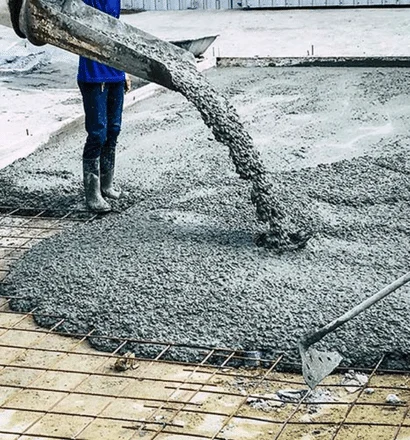
Ready Mix Concrete is a specially designed concrete produced in an automated batching plant using cement, sand, aggregates, water, and admixtures in carefully controlled proportions. The prepared concrete is transported to the construction site in transit mixers and is ready for immediate use.
Because every batch is produced under strict quality control, Ready Mix Concrete offers greater consistency, strength, and durability than traditional site-mixed concrete.
Cement vs Ready Mix Concrete: Understanding the Difference
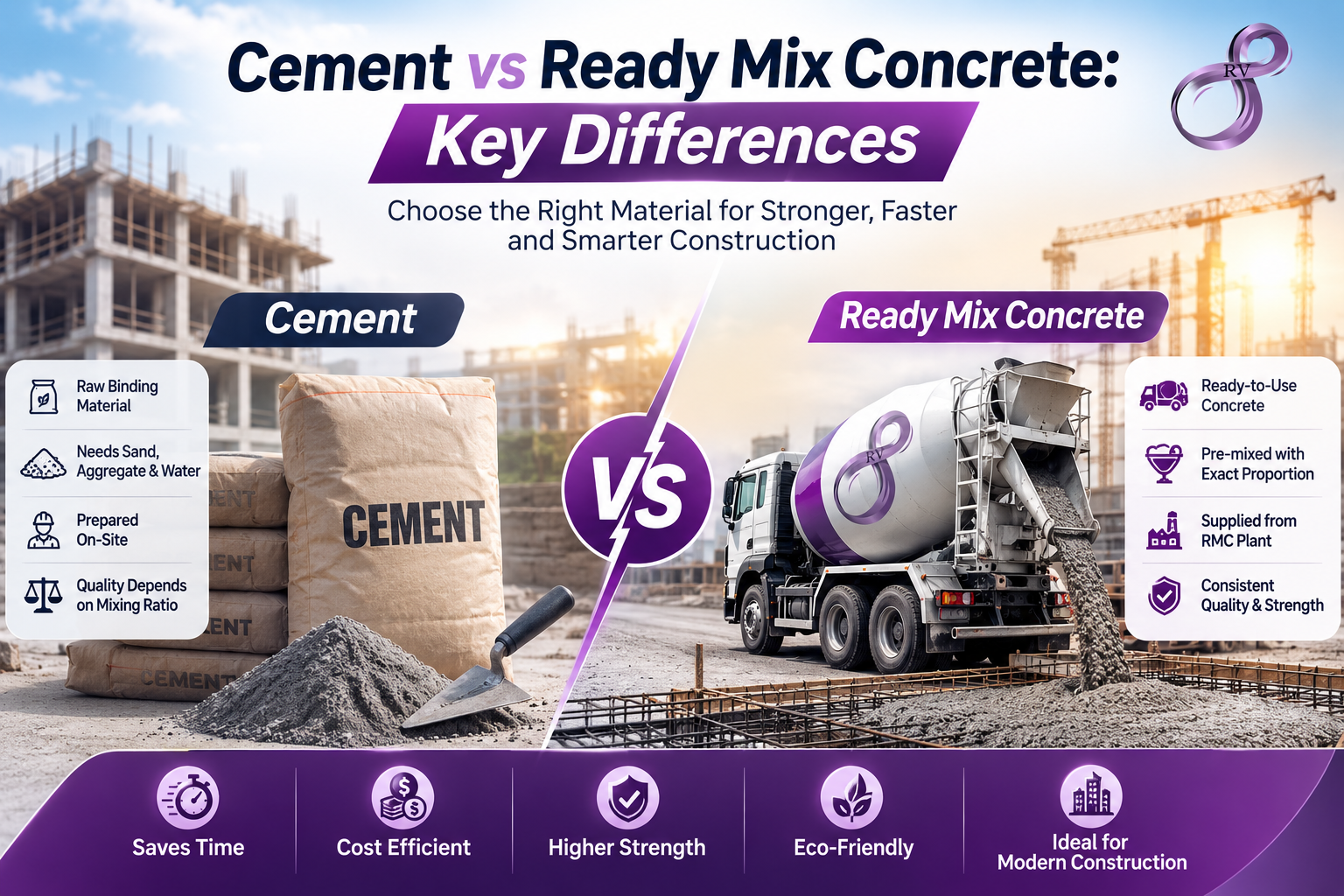
Although cement is a component of concrete, Ready Mix Concrete is a complete construction material. Cement is only one ingredient, whereas RMC contains all the ingredients needed to create strong structural concrete.
Think of cement as flour and Ready Mix Concrete as a fully prepared cake batter. Flour alone cannot make a cake, just as cement alone cannot build a structure.
1. Composition
Cement consists primarily of limestone, clay, gypsum, and other minerals that are processed into a fine powder.
Ready Mix Concrete is made from:
- Cement
- Sand
- Coarse aggregates
- Water
- Chemical admixtures
These materials are mixed in precise proportions according to the required concrete grade.
2. Manufacturing Process
Cement is manufactured in cement factories through high-temperature processing of raw materials.
Ready Mix Concrete, on the other hand, is produced in computerized batching plants where every ingredient is measured accurately before mixing.
This automated process ensures consistent quality throughout the project.
3. Purpose
Cement is mainly used as a binding material.
Ready Mix Concrete is the final construction material used for:
- Foundations
- Columns
- Beams
- Slabs
- Roads
- Bridges
- Industrial structures
- Commercial buildings
4. Strength
The strength of cement alone is very limited.
Ready Mix Concrete provides significantly higher compressive strength because it combines cement with aggregates and follows scientifically designed mix proportions.
5. Quality Control
When construction workers mix concrete manually on-site, the proportions often vary from batch to batch.
Ready Mix Concrete eliminates this problem because every batch is prepared under controlled laboratory conditions with strict quality checks.
6. Construction Speed
Using cement requires on-site mixing, which consumes time and manpower.
Ready Mix Concrete arrives ready for placement, allowing construction work to proceed much faster.
This helps contractors complete projects within deadlines.
7. Labor Requirement
Traditional site mixing requires workers for:
- Material storage
- Measuring
- Mixing
- Quality checking
- Handling
Ready Mix Concrete significantly reduces labor requirements because the mixing process is completed at the batching plant.
8. Material Wastage
Construction sites using loose cement often experience wastage due to improper storage, inaccurate measurements, and weather conditions.
Ready Mix Concrete minimizes wastage by delivering only the required quantity of concrete.
9. Cost Efficiency
Although purchasing cement may appear cheaper initially, the total construction cost increases due to labor, equipment, storage, and material losses.
Ready Mix Concrete often proves more economical because it reduces:
- Labor costs
- Material wastage
- Equipment rental
- Construction delays
- Maintenance expenses
10. Environmental Impact
Traditional concrete mixing creates significant dust and material waste.
Ready Mix Concrete is considered a more sustainable construction solution because:
- Less dust pollution
- Reduced material wastage
- Better resource utilization
- Cleaner construction sites
- Lower environmental impact
Why Modern Construction Prefers Ready Mix Concrete
Modern infrastructure projects require speed, consistency, and long-term durability.
Ready Mix Concrete has become the preferred choice because it offers:
- Superior strength
- Uniform quality
- Faster construction
- Better workability
- Reduced project cost
- Reliable supply
- Higher safety standards
- Long-lasting performance
From residential homes to highways and metro projects, RMC has become the backbone of modern construction.
Applications of Cement
Cement is commonly used for:
- Mortar preparation
- Plastering
- Tile fixing
- Brick masonry
- Manufacturing concrete
- Repair works
Applications of Ready Mix Concrete
Ready Mix Concrete is widely used in:
- Residential construction
- Commercial buildings
- Shopping malls
- Hospitals
- Schools
- Industrial plants
- Bridges
- Flyovers
- Highways
- Metro projects
- Airports
- Infrastructure developments
Why Choose Rock Ventures for Ready Mix Concrete?
At Rock Ventures, we supply premium-quality Ready Mix Concrete for residential, commercial, industrial, and infrastructure projects across Raipur, Bhilai, Durg, and other parts of Chhattisgarh.
Our advantages include:
- Modern automated batching plant
- High-quality raw materials
- Consistent concrete strength
- Multiple concrete grades
- Timely delivery
- Experienced technical support
- Reliable customer service
- Competitive pricing
Whether you’re building a house or managing a large infrastructure project, Rock Ventures delivers Ready Mix Concrete that meets the highest quality standards.
Tips for Choosing the Right Material
Before starting construction:
- Understand the difference between cement and Ready Mix Concrete.
- Select the appropriate concrete grade for your project.
- Estimate the required quantity accurately.
- Choose a trusted Ready Mix Concrete supplier.
- Follow proper curing practices for maximum strength.
Conclusion
Although cement and Ready Mix Concrete are closely related, they serve completely different purposes in construction. Cement is only one ingredient used to make concrete, while Ready Mix Concrete is a complete, ready-to-use construction material that offers better quality, faster construction, greater durability, and improved cost efficiency.
For modern construction projects, Ready Mix Concrete has become the preferred solution because it delivers consistent performance and superior structural strength.
If you’re searching for a reliable Ready Mix Concrete Supplier in Chhattisgarh, Rock Ventures provides high-quality RMC backed by advanced batching technology, strict quality control, and timely delivery. Whether your project is residential, commercial, or industrial, choosing Rock Ventures means building with confidence and quality.
Frequently Asked Questions (FAQs)
1. Is cement the same as Ready Mix Concrete?
No. Cement is a binding material, while Ready Mix Concrete is a complete mixture of cement, sand, aggregates, water, and admixtures.
2. Which is stronger: cement or Ready Mix Concrete?
Ready Mix Concrete is much stronger because it combines cement with aggregates in scientifically designed proportions.
3. Why is Ready Mix Concrete better than site-mixed concrete?
It offers consistent quality, faster construction, reduced wastage, better strength, and improved durability.
4. Can Ready Mix Concrete be used for home construction?
Yes. Ready Mix Concrete is ideal for residential homes, villas, apartments, and housing projects.
5. Does Ready Mix Concrete reduce construction costs?
Yes. It helps reduce labor costs, material wastage, equipment expenses, and project delays.
6. Why should I choose Rock Ventures for Ready Mix Concrete?
Rock Ventures provides premium-quality Ready Mix Concrete with advanced batching technology, timely delivery, multiple concrete grades, and dependable service across Chhattisgarh.